

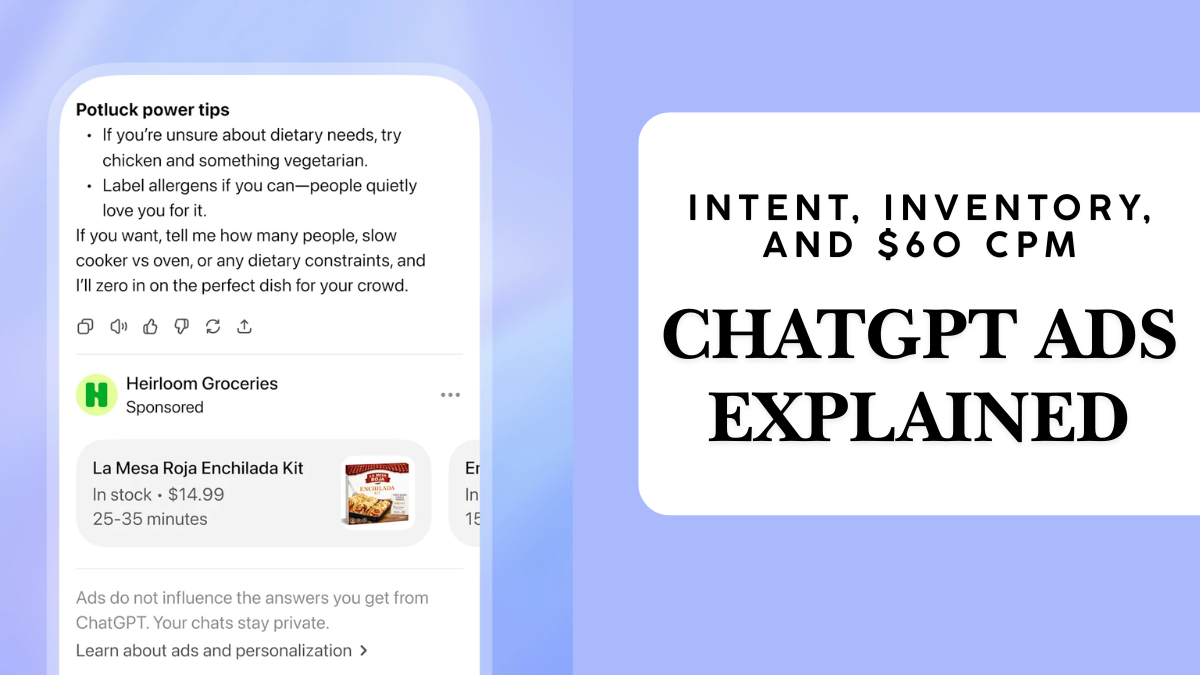
The digital marketing landscape just got a lot more expensive and a lot more personal. As of February 2026, the long-rumoured “ChatGPT Ads” have officially transitioned from being the “last resort to save OpenAI’s business model” in Sam Altman’s words to a $60 CPM reality on your screen.
While Meta has spent a decade perfecting the art of showing you retirement villas 3 minutes after you look at a gardening hat, OpenAI is betting that the “point of intent” is worth 3 times the price. Obviously, the $60 CPM that every other marketer seems to be talking about will likely come down over time as their ad inventory increases.
Read on to know what ChatGPT Ads are, how ChatGPT Ads work, why ChatGPT Ads are so expensive, and some quick FAQs.
What are ChatGPT Ads?
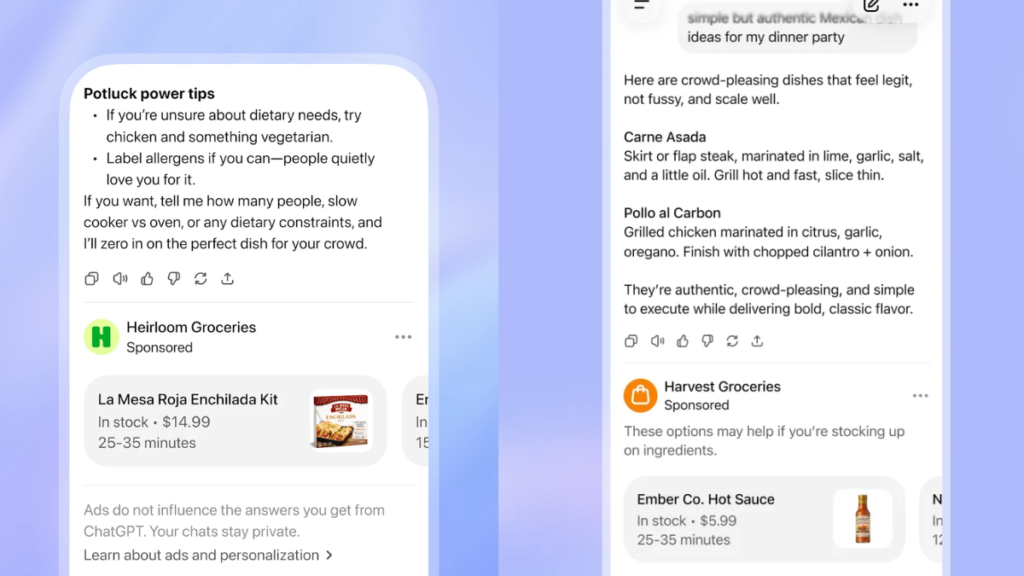
ChatGPT Ads are “sponsored” placements that appear within conversations. Unlike traditional digital ads, ChatGPT ads are “intent-based”. These ads will mostly be text-based, contextual, and part of a conversational interface. OpenAI says that in the near future, ads on ChatGPT will also be interactive, allowing users to ask direct questions to make purchase decisions.
Examples of ChatGPT Ads:
How does ChatGPT Ads Work?
ChatGPT Ads are still in their initial stages, but here’s a broad understanding of how all of this works:
- ChatGPT, as of Jan 2026, has over 700 million active users weekly (ref)
- Out of these, about 5% users, or 35 million, are paying subscribers of their Plus ($20/mo) or Pro ($200/mo) plans who will never see an ad (as per OpenAI’s claims)
- Only ChatGPT Free and Go tier users will see ads
- Ads run on separate systems from their core chat model, and advertisers have no ability to shape, rank, or alter ChatGPT’s responses
- An ad is displayed to a user based on the current topic of discussion
- Users’ chat context gets matched to an ad inventory.
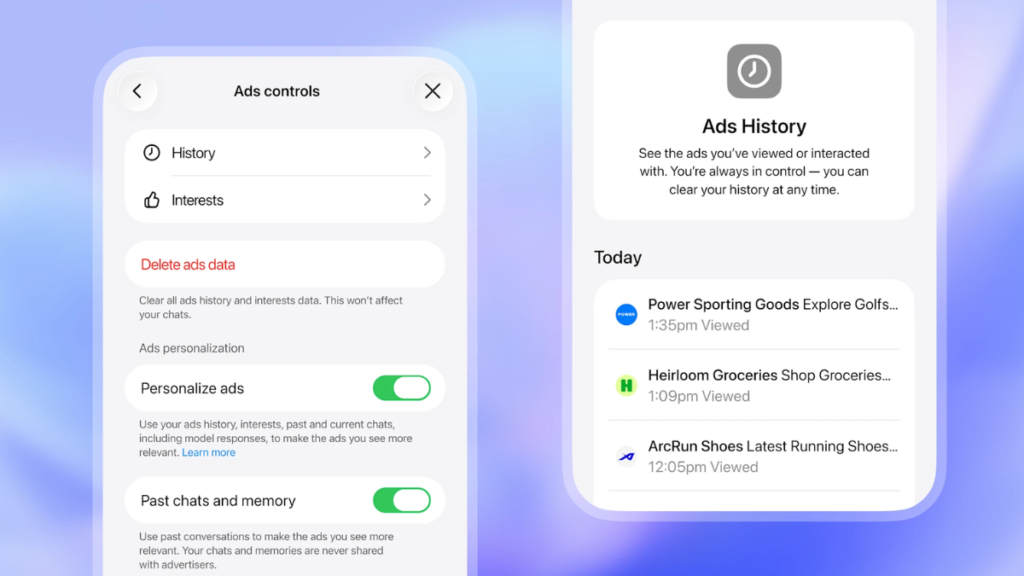
- If a user has enabled personalization, then factors like the user’s past history of chats, interactions, and stored memory data will also be considered.
- From the pool of relevant advertisers, the system ranks and selects a single sponsored placement (exact parameters of how the system ranks are still kinda unknown).
- The ad will be clearly labeled “Sponsored.”
- OpenAI says that the AI model itself does not know an ad is being shown unless the user explicitly chooses to ask about it (hard to believe we know)
- Conversations involving sensitive topics such as health, politics, or violence are excluded from ad matching entirely
- Advertisers only receive aggregated performance metrics like impressions and clicks
- If there is no high-quality, relevant match, no ad is shown at all, says OpenAI
For those interested in advertising on ChatGPT, visit https://openai.com/advertisers/ and fill out the contact form to share interest.
.
Why are ChatGPT Ads so Expensive? ChatGPT’s $60 CPM
At a staggering $60 CPM and a minimum $200,000 budget, OpenAI’s ChatGPT Ads might seem too expensive to some.
Some are even wondering if OpenAI has 700M weekly users, 35M are paid, and ads only show when relevant with sensitive categories excluded, and the ads frequency being conservative, is there enough inventory for scalability? Esp at a $60 CPM.
Out of the 700 million users, 35 million paid users (5%) would never see the ads, that automatically removes your chances of appearing in high-value users’ conversations.
Out of the 665 million users per week, not every conversation is going to be monetizable. This is simply because ChatGPT’s own usage data shows that only a fraction of conversations are commercially actionable.
We read this largest study conducted by OpenAI to show how people are using ChatGPTand found the following:
- According to OpenAI, 49% of usage falls under “Asking,” 40% under “Doing,” and 11% under “Expressing.”
- While “Asking” sounds commercially attractive, much of it revolves around informational queries like explanations, summaries, or general knowledge (not purchase intent)
- “Doing” includes drafting emails, writing code, planning trips, or completing tasks.
- “Expressing” consists of personal reflection, exploration, and play (typically, this category is highly contextual & sensitive)
Now, if we factor these stats along with the fact that premium subscribers are excluded, the realistic pool of monetizable impressions becomes meaningfully smaller.
In practical terms, only a subset of the 665 million weekly free users are engaging in commercially oriented conversations at any given time.
Which brings us back to why OpenAI can justify premium pricing despite constrained scale.
Opposed to legacy ad models like Meta or Google, built on taking educated guesses about users’ intent, ChatGPT captures intent in real time.
However, there is a behavioral gap that still exists.
Users may trust AI to guide discovery, but not necessarily to execute the purchase.
The research may happen inside ChatGPT, while the transaction may happen on Amazon, a brand website, or even offline. That creates an attribution challenge.
If Susan in California buys an espresso machine two days later, was it because of the ChatGPT Ad she saw? A Meta retargeting ad? A Google search? A billboard?
Conversational ads may drive influence, but influence is harder to measure than clicks. And that is where the real experiment begins.
.
FAQ on ChatGPT Ads
The following are some of the common questions that people may have and the answers to them:
Which ChatGPT users will see ads?
Ads are only shown to users on the Free and Go subscription tiers. If you have a Plus, Pro, or Enterprise account, your experience remains completely ad-free.
Can advertisers pay to influence ChatGPT’s answers?
No. OpenAI claims to maintain a strict wall between the AI and advertisers, meaning the model’s answers are ideally independent and uninfluenced by paid content.
How does OpenAI protect my privacy from advertisers?
OpenAI says, your actual conversations are never shared with advertisers. OpenAI handles the matching internally so brands only see general performance stats, not your private data.
Will ads appear in sensitive or private conversations?
OpenAI claims to use high-precision models to identify sensitive topics like health or politics. If a chat is flagged as sensitive, no ads will be shown.
What is the “Ask ChatGPT” button on an ad?
This feature lets you ask the AI questions about the specific ad you see. You can vet the product or check details before deciding to buy anything.
Can I turn off ad personalization?
Yes, users have full control to turn off personalization or even clear their ad data history in settings.
Why is OpenAI introducing ads now?
OpenAI says the goal is to fund higher usage limits and access to more powerful models for hundreds of millions of people who use the free version.
Do ads make the AI’s response less accurate?
As per ChatGPT, the AI model has no idea which ad is being displayed. It focuses entirely on giving you the best answer while the ad is handled as a separate, downstream step.
How often will I see ads while chatting?
OpenAI’s Ad Lead said in an podcast on their official YouTube channel that they are being conservative with frequency. You will only see an ad if the system finds a suggestion that is actually helpful and relevant to your current task.
How will ads work for small businesses?
The vision is to make advertising as easy as prompting. Small business owners can simply describe their goals and let the AI handle the complex bidding and targeting.